 Balance · Harmony · Prosperity
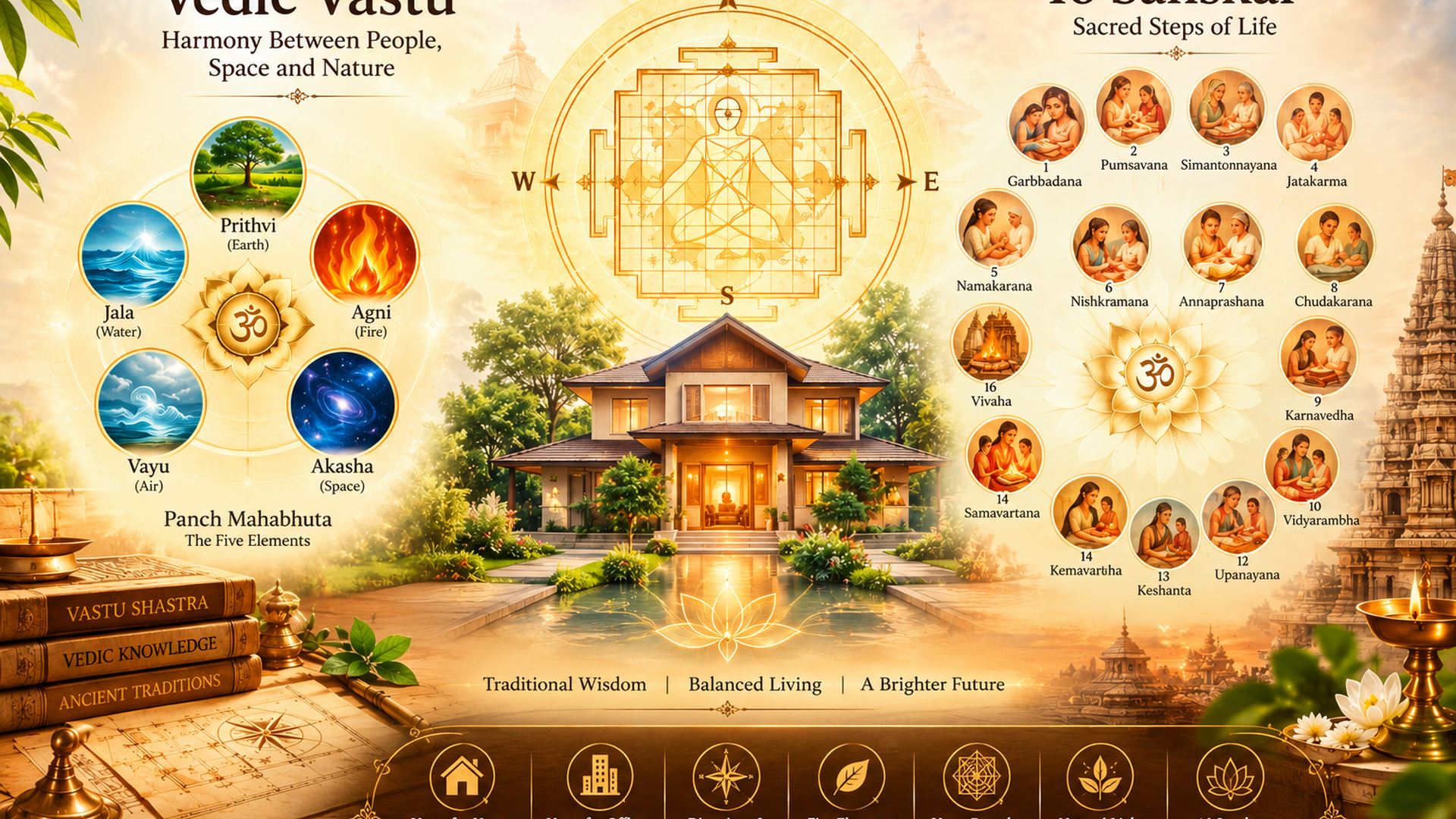
Vedic Vastu: Exploring the Complete Science of Vedic Vastu
Vedic Vastu is a traditional Indian system of spatial planning that explores the relationship between people, buildings, directions, natural elements, geometry, and the surrounding environment. It provides traditional principles for designing and organizing spaces in a balanced and harmonious way.
What Is Vedic Vastu?
Vedic Vastu focuses on important principles such as:
- Directions and orientation
- Panch Mahabhuta – Five Elements
- Vastu Purusha Mandala
- Entrance and room placement
- Natural light and ventilation
- Spatial proportions and geometry
- Site and plot selection
Five Elements in Vedic Vastu
The Panch Mahabhuta consists of:
- Prithvi (Earth) – stability and grounding
- Jala (Water) – flow and nourishment
- Agni (Fire) – transformation and vitality
- Vayu (Air) – movement and circulation
- Akasha (Space) – openness and expansion
Vedic Vastu traditionally explores how these elements are represented and balanced within a space.
Vastu Purusha Mandala
The Vastu Purusha Mandala is a traditional geometric framework used for organizing buildings and sites. It helps examine directions, room placement, proportions, central space, and overall architectural planning.
Vedic Vastu for Homes
Residential Vastu may consider the plot, entrance, bedrooms, kitchen, prayer area, bathrooms, windows, balconies, open spaces, lighting, ventilation, and internal circulation. The traditional objective is to create a balanced, functional, comfortable, and harmonious environment.
Vedic Vastu for Offices & Businesses
Vedic Vastu can also be explored for offices, shops, showrooms, hotels, clinics, restaurants, commercial buildings, and industrial properties. Planning may include entrances, work areas, management spaces, circulation, storage, utilities, and building orientation.
Vedic Vastu and Modern Architecture
Modern Vastu can be combined with contemporary principles such as natural lighting, ventilation, sustainability, ergonomics, accessibility, safety, and efficient space planning. Traditional principles should complement—not replace—modern architectural and engineering requirements.
Why Explore Vedic Vastu?
People explore Vedic Vastu for home planning, property selection, floor-plan analysis, architectural organization, directional understanding, and creating harmonious living and working environments. It is best understood as a traditional cultural and architectural framework, rather than a scientifically proven method for guaranteeing health, wealth, or other outcomes.
Conclusion
Vedic Vastu offers a comprehensive traditional approach to understanding space, directions, architecture, natural elements, geometry, and the relationship between people and their environment. When thoughtfully combined with modern architecture, safety, sustainability, and practical design, it can provide an interesting perspective on creating well-planned living and working spaces.
16 Sanskar in Vedic Tradition
The 16 Sanskar (Shodasha Samskara) are traditional Hindu rites that mark important stages of human life, from conception and birth through education, adulthood, marriage, and later life. They represent values, responsibilities, spiritual development, and important life transitions.
The commonly recognized 16 Sanskar are:
- Garbhadhana Sanskar – Rite associated with conception
- Pumsavana Sanskar – Traditional prenatal rite
- Simantonnayana Sanskar – Rite performed during pregnancy
- Jatakarma Sanskar – Ceremony associated with birth
- Namakarana Sanskar – Naming ceremony
- Nishkramana Sanskar – First ceremonial outing of the child
- Annaprashana Sanskar – Introduction of solid food
- Chudakarana Sanskar – First hair-cutting ceremony
- Karnavedha Sanskar – Ear-piercing ceremony
- Vidyarambha Sanskar – Beginning of formal learning
- Upanayana Sanskar – Sacred-thread and initiation ceremony
- Vedarambha Sanskar – Beginning of Vedic studies
- Keshanta Sanskar – Traditional rite marking maturity
- Samavartana Sanskar – Completion of formal education
- Vivaha Sanskar – Marriage ceremony
- Antyeshti Sanskar – Final rites after death
Vedic Vastu and the 16 Sanskar
The 16 Sanskar belong primarily to the broader traditions of Hindu life-cycle rituals, while Vedic Vastu focuses mainly on space, architecture, directions, elements, and the relationship between people and their environment. They can be discussed together within the wider context of Vedic knowledge and Indian traditions, but they represent different areas of traditional knowledge.